Instead of manually passing messages between your body shop and detailer, use an auto body shop paint correction workflow that records the repair scope, confirms paint-care restrictions, and schedules correction and ceramic coating only after approval. This 2026 guide shows you how to make that handoff without treating a finished repair as automatic permission to polish or coat fresh paint.
- An auto body shop paint correction workflow starts with written repair details and separate clearance for polishing and ceramic coating.
- JMatt Mobile Detailing suits NH Seacoast owners seeking mobile paint correction and ceramic coating assessed together.
- Resolve repair defects with the body shop before authorizing cosmetic correction.
- Confirm preparation, correction scope, coating scope, and mobile working conditions before booking.
Why this matters
A body shop repair and paint correction solve different problems. The body shop repairs and refinishes damaged areas; paint correction uses controlled abrasion to improve suitable surface defects. Ceramic coating adds a protective surface treatment, but it does not replace repair work or remove scratches.
The handoff should transfer instructions, not just the vehicle. A collection date tells you when the body shop releases the car. It does not, by itself, establish when every polishing process or coating is suitable for the repaired finish.
JMatt Mobile Detailing is best for NH Seacoast owners who want mobile paint correction and ceramic coating assessed together. Mobile service removes the need for a separate drop-off, but the working location and finish requirements still need agreement.
Before you start
- Get the repair paperwork and a body shop contact. Ask which panels were refinished, whether adjacent panels were blended, and what written paint-care instructions apply. Keep the completion date with those records.
- Prepare an inspection record. Use a shared document, email thread, or paper folder for photographs, repair notes, approvals, and the proposed correction-and-coating scope. No particular software is required.
- Check the hidden timing issue first. Permission to wash, polish, and apply ceramic coating are separate questions. Ask the body shop to confirm restrictions using the refinishing system's instructions; do not substitute a generic waiting period.
For a 2026 booking, send the paperwork before requesting a firm appointment. That lets the detailer assess the job around the actual finish instructions rather than an assumed schedule.
Repair handoff record
Use one handoff record for the job. The bold labels below are suggested document headings, not buttons or fields in a particular booking system.
Collect the repair information
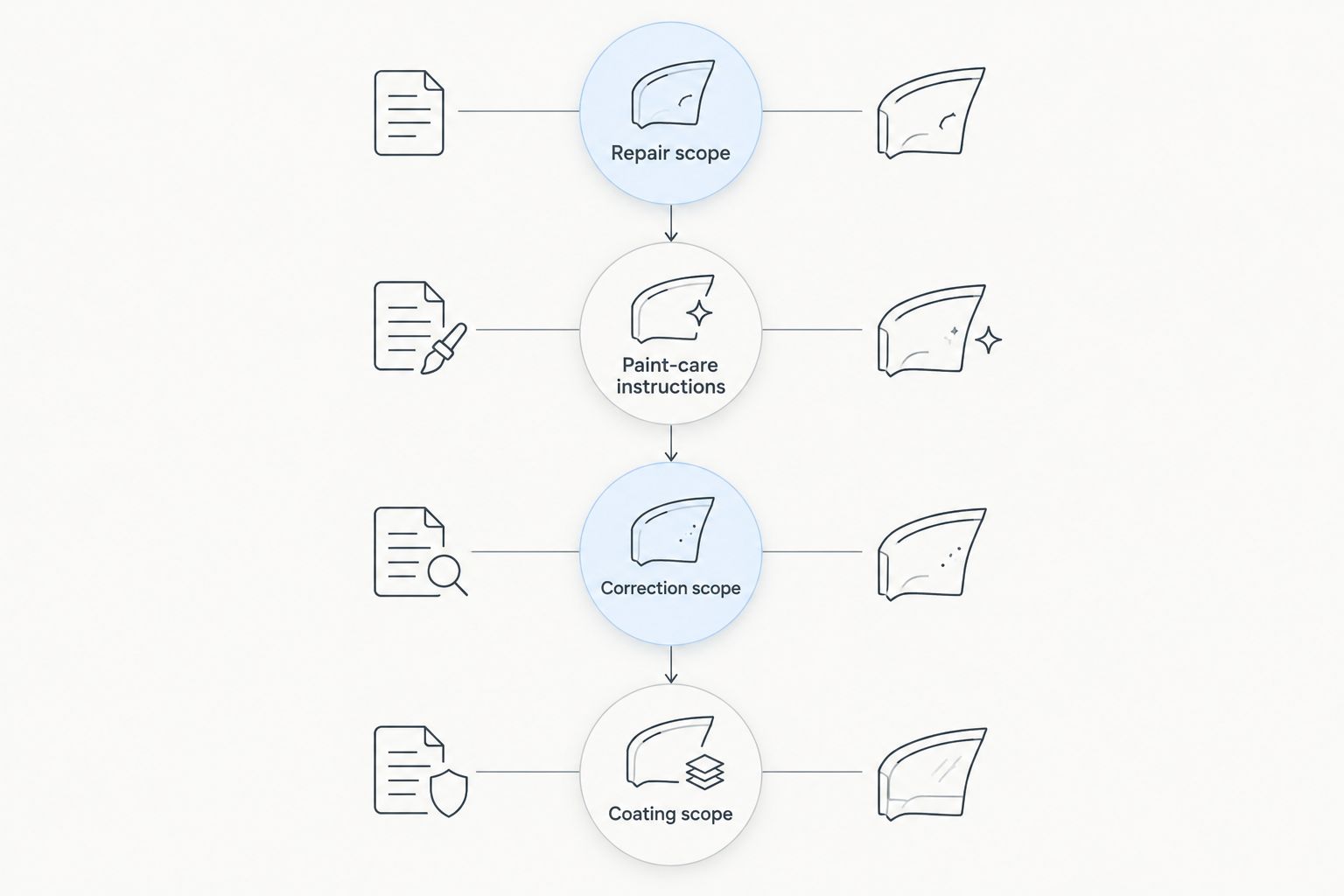
- Create Repair scope. List repaired, replaced, refinished, and blended panels using the body shop's description. Do not classify a nearby panel as untouched simply because the original impact was elsewhere.
- Add Paint-care instructions. Attach the body shop's written guidance and ask about washing, machine polishing, surface preparation, and ceramic coating separately. Record any conditions as well as dates.
- Create Condition photos. As a starting checklist, take 4 overview photos: front, rear, driver side, and passenger side. Add close-ups of repaired areas and visible concerns; the overview set does not replace detailed inspection.
Expected result: Your detailer can identify the repair area and restrictions without reconstructing the job from a telephone conversation.
Keep body shop messages in their original form. If you summarize an instruction, attach the original alongside it so a shortened note does not accidentally remove an important condition.
Separate repair concerns from correction goals
- Create Repair concerns. Record color differences, visible finish irregularities, overspray, scratches, or other issues you notice at collection. Describe their location without deciding how they must be fixed.
- Ask the body shop to review concerns connected to its work before another provider changes the surface. Give the shop a chance to inspect the finish while the condition is documented.
- Create Correction goals. Describe the improvement you want on the rest of the vehicle, such as reducing visible wash marks or making the overall finish more consistent. Keep those goals separate from unresolved repair concerns.
Expected result: You have a clear boundary between issues requiring body shop review and cosmetic work the detailer can assess.
For your 2026 handoff, keep dated photographs with the notes. A photograph documents appearance; it does not establish paint thickness, cure status, or whether a defect is safe to remove.
Correction and coating approval
Approve the finish plan before approving the appointment. A combined enquiry should explain the correction work and coating work together, while keeping their requirements distinct.
Confirm the finish plan
- Request an inspection of the repaired and surrounding panels. Ask the detailer to explain which defects are suitable for correction and which should remain untouched or return to the body shop.
- Record Correction scope and Coating scope separately. Specify the panels involved, preparation work, intended finish improvement, exclusions, and whether ceramic coating is part of the agreed service.
- Record Approval to proceed only after the body shop's paint-care guidance and the proposed detailing process agree. If an instruction is unclear, ask the providers to resolve it before work begins.
Expected result: You know what you are authorizing, what remains outside the job, and which restrictions govern the repaired panels.
A useful owner checklist contains 2 approvals: the body shop's confirmation of the applicable paint-care restrictions and your approval of the detailer's written scope. These approvals serve different purposes; neither replaces the other.
Choose the correct next action
| Next action | Best for | Advantage | Limitation |
|---|---|---|---|
| Proceed with the agreed work | A finish cleared for the proposed process | Connects correction and coating preparation in one plan | Requires inspection and explicit scope approval |
| Return for body shop review | Unresolved concerns about repaired areas | Keeps repair questions with the repair provider | Delays the detailing decision until concerns are resolved |
| Defer restricted work | Paint with outstanding care restrictions | Avoids proceeding against the refinishing guidance | Requires another scheduling decision after clearance |
These are decision routes, not interchangeable packages. Do not choose polishing simply because it is easier to book than a repair inspection.
The preparation deserves as much attention as the final coating. Ask how the surface will be inspected, cleaned, and prepared, and what finish limitations remain after the proposed correction. Do not interpret a coating enquiry as agreement that every visible mark will disappear.
Mobile appointment setup
Confirm the working location and handover
- Create Site requirements. Ask about suitable working space, shelter, lighting, access, utilities, and weather arrangements. Record what the provider needs rather than assuming every driveway supports every process.
- Add Appointment conditions. Note the approved work, vehicle access arrangements, and any instructions for handling the vehicle before and after treatment. Confirm the schedule directly; repair completion alone does not determine the detailing appointment.
- Create Final handover. Ask for a review of completed work, remaining defects, coating scope, and written aftercare instructions. Keep these with the repair record.
Expected result: The appointment has a suitable location, an agreed scope, and a clear handover rather than unresolved questions on arrival.
JMatt Mobile Detailing provides mobile services across the NH Seacoast, including Exeter, Portsmouth, and Dover. For Rye, North Hampton, NH, or Newburyport, MA, confirm your address and the requested combined service before making arrangements.
If your main question is timing, read whether paint correction and ceramic coating can be done in one visit. A combined visit still depends on the finish, preparation requirements, working conditions, and agreed service scope.
Discuss your post-repair finish
Ask about mobile paint correction and ceramic coating, repair restrictions, and the scope for your vehicle.
When only part of the car needs work
A repaired panel can have different restrictions from the surrounding factory finish. Use a panel-specific handoff instead of treating the whole vehicle as one uniform surface.
- Mark the restricted panels. Identify them in the written record and photographs. Include blended areas identified by the body shop.
- Ask about separate treatment boundaries. Have the detailer explain whether work on other panels is practical without conflicting with repair instructions.
- Record existing protection. Tell the detailer about any known ceramic coating and which panels were repaired. Do not assume the repaired area retains the same protection as the rest of the car.
- Confirm the later decision. If restricted panels remain untreated, agree how their condition and coating scope will be reassessed after clearance.
Partial work needs an explicit boundary, not an informal promise to avoid the fresh paint. For a 2026 appointment, keep the current panel map with the current scope so an older version does not guide the work.
The benefit is a more precise plan. The drawback is that separate treatment can require another appointment, and you should not assume a uniform finish before the whole vehicle has been assessed.
Troubleshooting the repair-to-detailing handoff
The body shop says the car is ready, but gives no coating guidance
Ask whether ready means ready for collection or cleared for the specific polishing and coating process. Request written paint-care instructions tied to the refinishing work. Leave restricted work unscheduled until the question is resolved.
A mark remains after the repair
Photograph the mark and ask the body shop to inspect it before authorizing abrasion. A visible mark is not enough information to decide between repair, correction, or leaving the area alone. Ask the detailer to explain any safe correction limits.
The body shop and detailer give different instructions
Send both providers the same repair details and ask them to clarify the conflict directly. Do not choose the shorter waiting period or average two recommendations. The proposed process must respect the applicable refinishing instructions.
The mobile location is unsuitable on appointment day
Use the site requirements recorded before booking to discuss an alternative arrangement. Do not pressure the provider to apply a coating in unsuitable conditions. Confirm any changed location or schedule before handing over the vehicle.
You expected ceramic coating, but the scope only lists polishing
Stop and clarify the written scope before work begins. Paint correction does not establish that ceramic coating is included, and a coating enquiry does not establish how much correction is included. Approve the revised scope only after both are clear.
Customize your workflow
For a straightforward repair, one shared record is enough. For several repaired or blended panels, organize the record panel by panel so photos, restrictions, and approved work stay together.
If you are booking in 2026, ask JMatt Mobile Detailing about correction and ceramic coating in the same enquiry. Include your town, repair paperwork, collection date, photos, and your finish priorities. Then ask what assessment and working conditions are needed before the service can be agreed.
Make the enquiry about preparation and finish, not just appointment length. Mobile convenience helps with the handoff, but a useful booking conversation still needs to establish the work your vehicle actually needs.
FAQ
Can I book paint correction as soon as my body shop finishes?
You can make an enquiry immediately, but confirm paint-care restrictions before authorizing the work. Collection approval is not automatically approval for every polishing or coating process.
How long should I wait before ceramic coating repaired paint?
Use the written guidance for the refinishing system used on your vehicle. Ask the body shop to confirm the applicable restrictions and have the detailer check them against the proposed coating process.
Does ceramic coating remove scratches left after a repair?
No. Ceramic coating is not a scratch-removal process; unresolved repair concerns need assessment before any correction or coating is approved.
Can paint correction and ceramic coating be booked together?
Yes, you can request an assessment for both services together. Confirm the correction scope, coating scope, paint restrictions, and appointment arrangements rather than assuming both are included.
What should I send a detailer after body shop repairs?
Send the repair scope, refinished and blended panel details, written paint-care instructions, and condition photographs. Include unresolved concerns and your goals for the overall finish.
Can I arrange mobile correction and coating in Exeter, NH?
JMatt Mobile Detailing serves Exeter within its NH Seacoast service area. Confirm the combined service scope and working-location requirements; for Rye, North Hampton, or Newburyport, confirm address coverage directly.
One last thing
Ask for the written aftercare instructions before the appointment, not only at collection. They let you plan where the car will stay and how you will use it afterward, without guessing at restrictions. A good handoff ends with clear care instructions, not just a glossy finish.